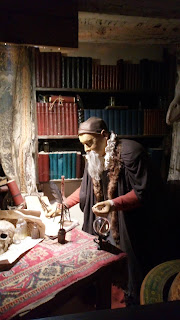
A recent visit to Stratford upon Avon – famously the birthplace of William Shakespeare – saw my husband and I making a trip to a place that fascinated me. Tudor World is to be found right in the centre of the town housed in a sixteenth century building known as the Shrieve’s House (formerly owned by Henry VIII).
Here, in a series of beautifully constructed
rooms, scenes from everyday life in Tudor England are reimagined, including their
home life, education, superstitions and beliefs, and it is in these latter two
areas that my interest was well and truly spiked, For here, suddenly (and not for the first time), I was
brought up close and personal with that most enigmatic of Tudor characters, Dr.
John Dee.
Known as ‘Conjuror to Queen Elizabeth’, he
was a man of many talents and many parts. He has long captured my imagination
and attention and the display at Tudor World simply reignited the flame that
has been burning away at the back of my mind for years.
So who was he?

John Dee was born in London on July 13th
1527. From his earliest years, it became apparent to his father (a minor figure
at Henry VIII’s court) that his son was possessed of a fearsome intellect. At
the tender age of fifteen, the young Dee attended Cambridge University where he
spent twenty out of every twenty-four hours in deep study. Latin, Greek, Mathematics,
Medicine, Astronomy, Geometry were just some of his subjects – along with
Cryptography, such a valuable skill for a future spy.
Still in his twenties, he moved to Paris
where he lectured in Algebra and must have been a powerful and charismatic
teacher because he swiftly became popular and widely respected, packing the
halls whenever he spoke, at venues throughout Europe. He rose to become England’s
top scientist, developing navigational systems that would help transform his
country into the naval superpower it would become under Elizabeth.
It was while he was at the University of Louvain
in the Netherlands that Dee studied the occult. This was not unusual in those
days as the study of science and magic went hand in hand with the constant
quest to understand the nature of God.

With such fame and reputation, he was bound
to come to the attention of the new monarch. In fact he did so before she was
even crowned. When Elizabeth I inherited the throne, Lord Dudley asked Dee to
predict the most propitious day for her coronation. From then on, the Queen
studied his mystical writings and took to regular consultations with her new ‘conjuror’. Many years later, she took his advice on the timing of the English attack on the Spanish Armada.
Dee, it was said, cast a spell that brought huge waves crashing down on the enemy
fleet as they advanced toward England’s shores. More likely, he used his
knowledge of Meteorology to predict oncoming severe storms. Whatever the truth
of it, he got his calculations right. Elizabeth followed his advice and the
attack took place precisely following Dee’s advice.
With such a track record of success, Dee’s
star could only rise, and it did. Having said that, the Queen made many
promises to him that she failed to honour.

Such formidable intellect as Dee’s often treads
a precarious path between genius and madness, and Dee appears to have been no
exception. As he grew older, he became increasingly obsessed with communicating
with angels, using various forms of necromancy including scrying (using a crystal).
The results were disappointing but then he recruited a somewhat dubious character,
many years his junior. Edward Kelley was twenty-six, an apothecary afflicted
with alcoholism who had been punished for counterfeiting coins (he had had his
ears cropped). He seems to have won over the academic with his claims for
success in the fields of scrying and sorcery and because he claimed to have
discovered the famed philosopher’s stone. Dee may have been convinced by him
but his wife, Jane, detested him. She clearly believed him to be a charlatan
who would drag her husband’s name and reputation into the gutter. Ignoring her
concerns, Dee collaborated with Kelley for the next ten years, reporting
success on contacting the angels who would transmit pronouncements and
prophecies, but the rot was setting in.
In 1583, Dee and Kelly left England for
Poland and while he was away, his house, with its incredible library (by far
the largest in the country) was ransacked by a mob who believed him to be a
wizard. Manuscripts and books were burned and destroyed. When he returned, his frequently
fluctuating fortunes vastly depleted and following a final quarrel with Edward Kelley,
plague swept England. Dee was widely
blamed for it, even though it took his wife and four of their eight children.
The Queen helped him out of his parlous
financial state and in 1595, he became warden of Manchester College.
When Elizabeth I died in 1603, the pendulum
finally swung toward penury where it would remain for John Dee. Under the anti-sorcery.
witch-hating James I, he was in a precarious position. Penniless and ageing, he
spent the rest of his days selling his books and casting bespoke astrological
charts. He was eighty-one when he died – a grand old age for those
pestilence-ridden days. He was buried in Mortlake where he had made his home
for so many years. Don’t go looking for a gravestone though as it has long since
disappeared. However, if you are ever in Manchester, take a trip to the oldest
public library in the English-speaking world– Chetham’s Library – where a
scorch mark on a desk is said to have been made by the cloven hoof of a devil, conjured
up by the good doctor himself…

Now it only remains for me to wish you and yours the best of times and happiest of festive seasons. Don’t forget to curl up with a good ghost story. M.R. James perhaps. Or you can try one of mine if you like. Here’s a couple to be going on with:

See you all, safe and sound I trust, in 2022.
Images:
Author's own (photographed at Tudor World, Stratford upon Avon)
Shutterstock
Crossroad Press
Silver Shamrock Publishing


